
Project Summary
Feeding a growing world population where all food production is under pressure from climate variability and change requires an increased focus on aquatic food systems to implement sustainable pathways to reach the UN SDGs. Aquatic foods, in particular seafood, comprise important sources of micro- and macro-nutrients essential for ensuring healthy diets, particularly for young children. ClimeFOOD will directly contribute to more sustainable and climate-resilient food systems, to the UN SDGs, and to outcomes from both the UN Ocean and Nutrition Decades. Through a holistic food-systems approach embedded in a coherent open-access analytical framework, ClimeFOOD will develop and implement pathways for improving health under the challenges of climate change. As an open partner network, ClimeFOOD will address optimal nutritional yield from fisheries and aquaculture founded on sustainable ecosystems and viable blue bio-economies, while being particularly mindful of small-scale actors in LDCs.
Strategic Aims
- Increase the consumption of aquatic food to:
- Feed a growing world population
- Combat malnutrition, in particular among children
- Contribute to climate action
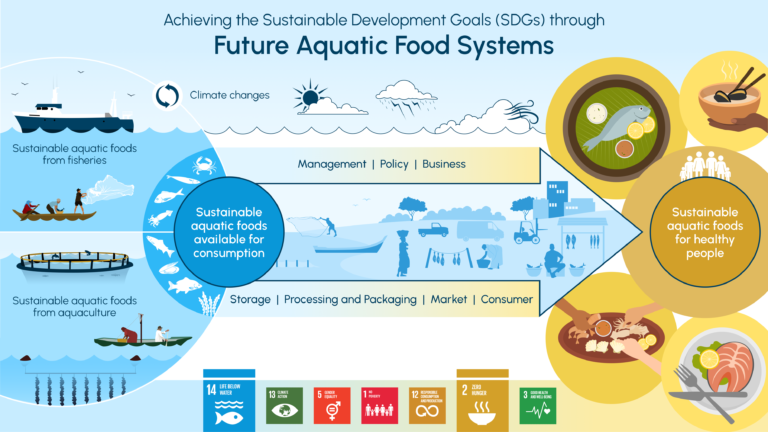
- Future aquatic foods need to be
- Climate-friendly
- Environmentally sustainable
- Healthy and nutritious
- Profitable to produce and sell
- Socially equitable
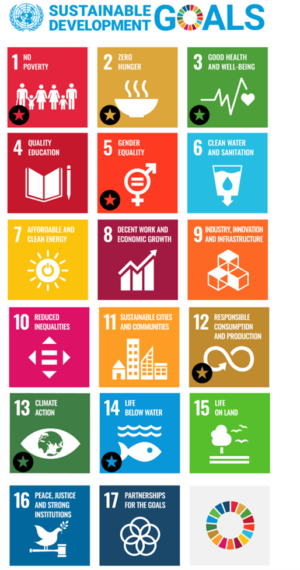
- ClimeFOOD will contribute directly to achieving the SDGs
- In particular # 1, 2, 3, 5, 12, 13 and 14
Expected Outcomes
- Integrate an updated knowledge base on impacts on the sustainability dimensions:
- Climate change
- Environmental health
- Seafood nutrition and safety
- Profitability
- Social equity
- Co-create interdisciplinary analytical approaches linking methods and models for the different dimensions of sustainability to:
- Identify management actions and business opportunities that are sustainable in all dimensions and contribute most effectively to achieving the SDGs
- Case studies in the global south
Analyzing Integrated and Balanced Sustainability
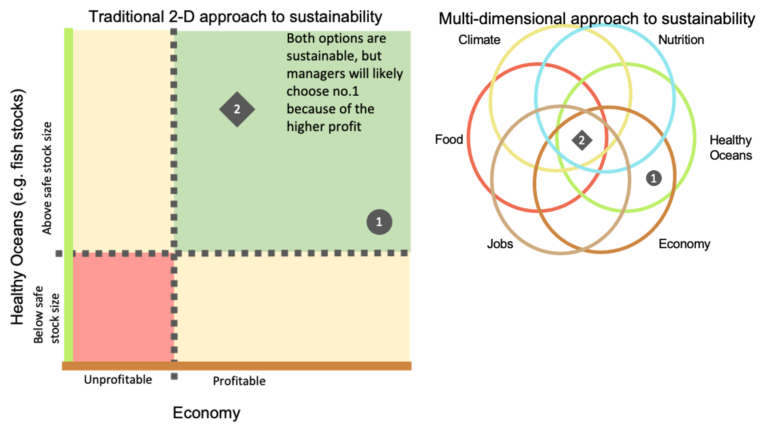
- An integrated and balanced approach is necessary to achieve all the SDGs by 2030
- Requires analysis and evaluation of multiple sustainability dimensions
- We need to move away from a sectoral approach and instead manage our future seafood systems in an integrated manner
- Requires identifying and understanding the potential trade-offs to find a sustainable balance
Connection with Other UN Ocean Decade Actions
- ClimeFOOD is a Project under the IOC OD structure
- All projects should be associated with a Program
- The Sustainable Blue Food Futures for People & Planet is a new (March’23) OD Program, led by Michelle Tigchelaar (Standford, BlueFood Assessment) aiming to:
- Further our understanding of the roles of blue foods
- Better integrate blue foods in policies and agreements
- Develop a series of blue food solution initiatives
- investing in a global community of practice
- There is a clear complementarity between ClimeFOOD and Blue Food Futures
- ClimeFOOD will be organized as a project under ‘Blue Food Futures’
Existing ClimeFOOD Activities among the Partners
- Aim: to identify synergies and opportunities for collaboration
- Use to develop new partnerships for future project ideas
Partner list:
New Project and Case Study Ideas
- Improving the knowledge base
- Developing methods
- (e.g. for integrated and multi-dimensional analysis of sustainability)
- New seafood products and seafood business chains
- Outreach campaigns
- Case studies in Global South and Global North
- Small-scale and industrial
- Build on existing country collaboration (e.g. Mozambique, Kenya, Ghana, Cuba, Columbia, Sri Lanka)
- Partner with EAF Nansen Programme
- More++