
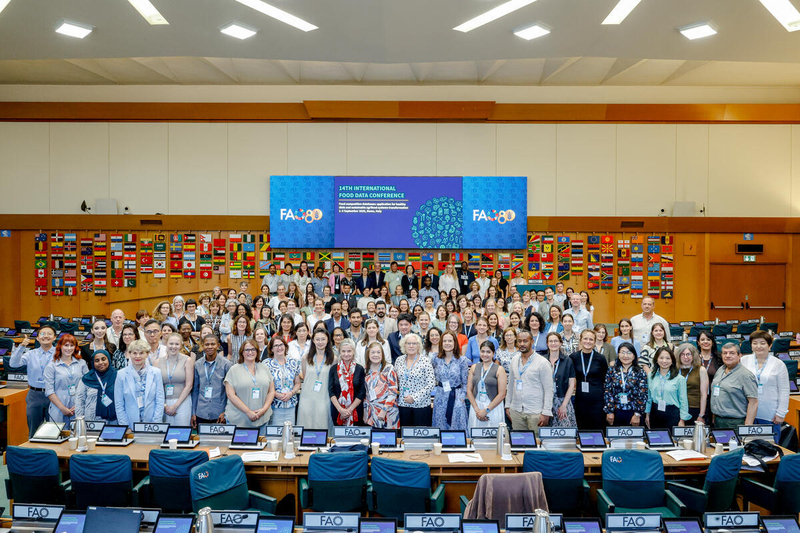
 Photo: © FAO / Giuseppe Carotenuto
From 1–3 September 2025, FAO hosted the 14th International Food Data Conference (IFDC) in Rome, Italy. Led and organized by FAO’s Food and Nutrition Division (ESN), in collaboration with global partners, the three-day event brought together around 180 experts from over 40 countries to explore the latest developments in food composition data – the detailed information about the nutrients and components in the foods we eat.
Why food composition data matters
Food composition data helps us understand what’s in our food – macronutrients like carbohydrates, proteins, and fats, as well as vitamins, minerals, and other components. This data is essential for promoting healthy diets, informing nutrition policies, and guiding the transformation of agrifood systems.
Spotlight on Aquatic Foods
Aquatic foods data featured prominently at the IFDC, with a total of 11 presentations emphasizing its growing importance across disciplines. Several members of the GAN Working Group on Food Composition Data contributed to these discussions, reflecting the group’s strong engagement in improving data for aquatic foods.
In his opening remarks, Manuel Barange, FAO Assistant Director General and Director of the Fisheries and Aquaculture Division, highlighted the importance of food composition data in demonstrating the full nutritional value of aquatic foods and emphasized the need for more high-quality data to fully unlock their potential.
Doris Rittenschober, Food Composition Specialist at FAO ESN, presented on the Update and Expansion of the FAO/INFOODS Global Food Composition Database for Fish and Shellfish. Her presentation revealed that although progress has been made, reliable data is still missing for several nutritionally important aquatic species. The updated and expanded database (release in 2026) aims to address these gaps by including more species —including seaweeds—enhancing the quality and accessibility of aquatic food data worldwide.
Marian Kjellevold, Research Professor at the Institute of Marine Research, Norway, presented Bridging the data gap: expert guidelines for the reporting of analytical data in aquatic foods for use in food composition databases. Her presentation revealed insufficient methodological details are frequently published journal articles and how this hinders quality assessment and use of the data. She highlighted that addressing these issues would boost data reuse, enhance scientific value, and save funds.
Other presentations explored a wide range of topics, for example, how new seaweed compositional data can be translated into practical tools to guide consumer choice and fisheries management toward nutrition-sensitive outcomes; locally processed fish products or powders and their potential contribution to the diets of specific population groups; and how existing global food composition databases can help close nutrient data gaps to unlock the full potential of aquatic foods for nutrition.
The 14th IFDC reaffirmed FAO’s leadership and the global momentum to improve the quality, availability, and use of food composition data for healthy diets and sustainable agrifood system transformation. A Special Issue in the Journal of Food Composition and Analysis will be released in 2026 with accepted peer reviewed papers from the Conference.
Conference recordings