In Autumn 2025, Fresh Water Farms Europe (FWFEU) joined the Future17 Global Challenge Programme with a dedicated project on “Systems Approach to Climate-Resilient Aquaponics for Sustainable Aquatic Foods.” The initiative is implemented in partnership with QS Impact and a global consortium of universities, including Stellenbosch University, the University of Exeter, Duke Kunshan University and The American University of Sharjah. This collaboration directly supports the Global Action Network mission to advance sustainable aquatic foods for food security and nutrition.
The project brings together an interdisciplinary and multicultural team of Future17 students who work alongside FWFEU to understand how aquaponic systems can be designed and operated to be climate-resilient, circular, socially inclusive and nutrition-sensitive. Using a systems-thinking and SDG-led approach, the team is:
● Mapping key drivers, constraints and enablers for aquaponics implementation in different socio-environmental settings;
● Comparing use cases such as arid and water-scarce regions, peri-urban production in Europe, and controlled/closed-loop or analog environments;
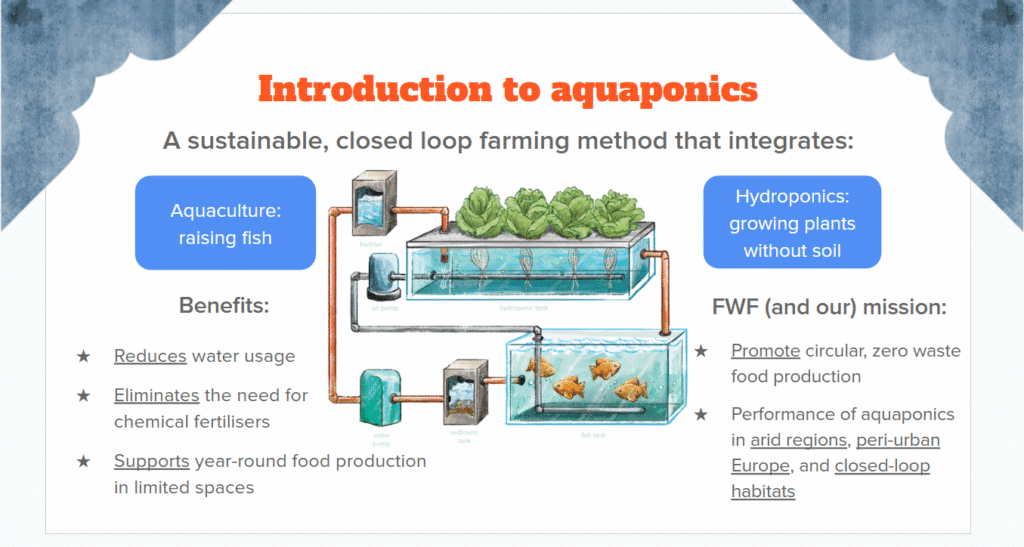
● Exploring how aquaponics can contribute to sustainable “blue foods” by improving water efficiency, nutrient recovery, waste reduction and consistent supply of safe, nutritious aquatic products and vegetables.
The students are developing conceptual and analytical tools to support decision-making by practitioners, investors and policymakers interested in integrating aquaponics into food systems transformation strategies. This includes system diagrams, preliminary modeling approaches and scenario-based thinking to assess trade-offs and co-benefits across sustainability dimensions (environmental performance, affordability, governance, equity, and links to local diets and markets).
During the mid-project review, it was especially inspiring to see how the team integrated diverse academic backgrounds (engineering, environmental science, social sciences, policy, business) and cultural perspectives to co-create a more holistic understanding of aquaponic food systems. Their work highlights the importance of context-specific design, stakeholder engagement and inclusive governance to ensure that climate-resilient aquaponics can genuinely support vulnerable communities and contribute to “leaving no one behind”.
The project benefits greatly from the guidance of Dr. Selim Haj Ali (University of Exeter) and Dr. Noha M. Hassan (The American University of Sharjah), who serve as mentors within the Future17 framework, bringing critical reflections on sustainability assessment, systems thinking and regional relevance. In addition, Dr. Alejandro M. Gómez-San-Juan (University of Vigo) contributes as an external advisor, reinforcing scientific rigor and strategic vision for future implementation and scaling opportunities. By connecting educational innovation, scientific expertise and real-world challenges, this Future17 collaboration strengthens the evidence base for sustainable aquatic foods and positions aquaponics as a practical solution to climate and resource constraints. It showcases how youth-led, cross-institutional projects can contribute to the Global Action Network’s objectives by generating actionable knowledge, raising awareness and catalysing partnerships that link “healthy waters” with “healthy people” across regions and sectors.
Contact: Juliana Gadelha, Founder, Fresh Water Farms
Europe (FWFEU) – admin@freshwaterfarmseu.eu
Partners & stakeholders:
- QS Impact / Future17 Global Challenge Programme
- Stellenbosch University
- University of Exeter
- Duke Kunshan University
- The American University of Sharjah