
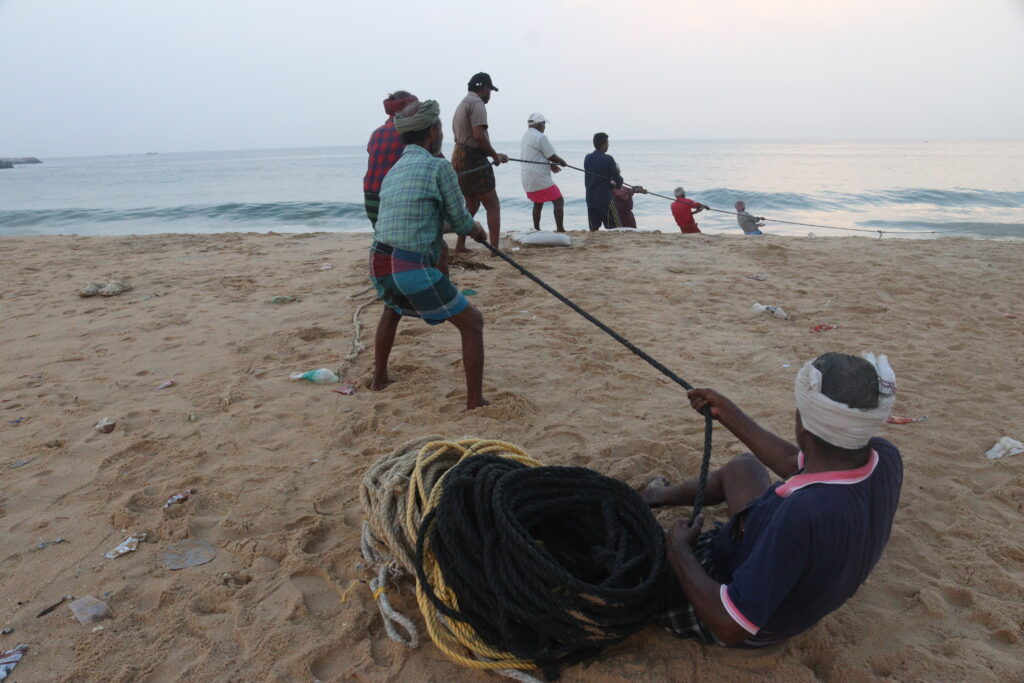
| An immersive two-month research program hosted by Christ (Deemed to be University), India, among the fishing community of St. Andrews, Puthenthope and Perumathura beaches in Kerala’s capital district, Trivandrum, focused on documenting the slowly fading practice of shore seine fishing, also known as ‘karamadi’ or ‘kambavala’ in the local language (Malayalam). The study was conducted by drawing on narratives from fishermen who still practice or have previously practised shore seine fishing. The programme included participation by five undergraduate students from the economics and life sciences disciplines under the supervision of Dr Maximillian Martin (Professor, Department of Life Sciences) and Godwin VP (Assistant Professor of Economics). Shore seine fishing is one of the oldest forms of collective fishing on the coast of Kerala. A large net is taken out by boat, cast in a wide arc, and hauled in by teams pulling from both ends, standing on the beach. When the practice of shore seine was at its peak, a single casting involved thirty to sixty people working in tight coordination, guided by accumulated knowledge of the sea, the seasons, and each other. The operation was not merely a fishing method but a social institution in itself, serving as a social safety net for the old and disadvantaged, as it allowed physically weaker fishermen who could not afford to go out to sea in boats to brave the rough sea. But in recent decades, the practice of shore seine fishing has seen a sharp decline along the Kerala coast. According to the villagers of St. Andrews beach, operations of large trawlers and mechanised boats have drastically reduced the number of fish that come closer to the shore for these fishermen to catch. According to an interviewee, species such as sardines, which were once caught in abundance, have long been unnoticed. Unsustainable fishing practices by trawlers have led to a decline in catches and thus affected the revenue of shore seine fishers, which is a small-scale and sustainable form of fishing. There are parts of India where shore seine fishers don’t follow the guidelines for the mesh size of the nets, which leads to juvenile catches, but compared to the harm caused by large-scale fishers, it is negligible. Along with this, the change in climate and ecological conditions has multiplied the effects of low catches. Unhealthy coral systems, rising seawater temperatures etc have negatively affected the fish population. Fishermen in some places like Valiyathura and Beemapally (both situated in Trivandrum), are no longer able to practice shore seine fishing because of rising sea levels and erosion of the beach, as without a shore, the fishermen simply cannot pull the nets ashore. According to the fishermen of St. Andrews beach, fishermen from Valiyathura and Beemapally come to their beach to cast nets, and they are happy to host them. But most of the time, the money they get from the catch will not even cover their transportation costs, let alone make a profit. All of these factors lead younger members of the community to be averse to shore seine fishing and to engage in other livelihood methods. According to the participants interviewed, the practice of karamadi will cease to exist within the next ten to fifteen years. Along with it will go the chants, songs, and knowledge about the sea that have been passed down for generations within the community. Faculty Supervisers: 1. Dr Maximillian Martin max.martin@christuniversity.in 2. Dr Godvin V P godvin.vp@christuniversity.in 3. Dr Amruth P amruth.p@christuniversity.in Student participants: 1. Angel Elizabeth, angel.elizabeth@baesh.christuniversity.in 2. Devika Jayan, devika.jayan@bscbzh.christuniversity.in 3. Karen Verghese, karen.verghese@bscczh.christuniversity.in 4. Ebin Kurien Mathews, ebin.mathews@baesh.christuniversity.in 5. Reuben Sam Philip, reubensam.philip@baesh.christuniversity.in |